
 Good Schools Guide
Mr.P’s Parent Maths Problem of the Week
Hello parents,
Thank you to everyone who had a go at last week’s grid puzzle. It’s a great example of using structure and careful reasoning rather than trial and error.
The key observation is that the numbers 1 to 8 add up to 36. Since the grid has 2 rows, each row must total 18. Similarly, with 4 columns, each column must total 9. This gives us a clear target to work towards in every row and column.
From there, a helpful strategy is to focus on columns or rows that already contain numbers. For example, the first column already has a 3, so the number above it must be 6 to make 9. The second column has a 4, so the number below must be 5. Continuing this process of “completing to 9” for each column allows the grid to gradually fill itself in. As the numbers fall into place, the only value that can go in the green square — while keeping both its row and column totals correct — is 7.
This puzzle highlights how breaking a problem into smaller targets (like making 9 in each column) can make a complex-looking problem much more manageable.
Well done to everyone who worked that out.
Solutions will be published in the following week’s edition of the Barrow Hills Bulletin.
Problem 10: 20 March 2026
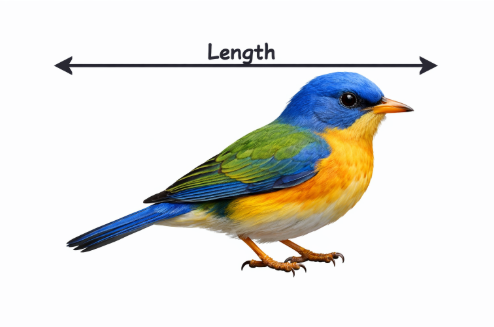
The head of a bird is 9 cm long. Its tail is equal to the size of its head plus half the size of its body. Also, its body is equal to the size of its head plus its tail. What is the total length of the bird?