
 Good Schools Guide
Mr. P’s Parent Maths Problem of the Week
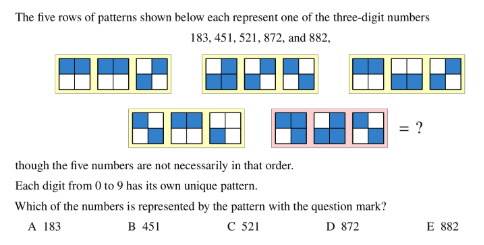
Last week’s problem (see below) asked you to ‘decode’ a series of coloured squares. Each set of squares represented a specific number between 1 and 8. Your job was to determine which set of squares corresponded to which number.
To do this you would to notice that each small blue-and-white square represents a single digit, and the same pattern always stands for the same digit. The key observation is to count how many times each pattern appears across all five rows.
One particular pattern appears four times, so it must represent the digit 8, because 8 occurs four times in the list of numbers (183, 451, 521, 872 and 882). In the first row, the same pattern appears twice followed by a different pattern, so that row must represent 882, the only number with two identical first digits. This tells us which pattern stands for 8 and which stands for 2. Using this information, the second row can be identified as 521, allowing the remaining patterns to be matched to the digits 5 and 1.
Finally, the row with the question mark contains the patterns for 4, 5 and 1, so the missing number must be 451, giving answer B.
Problem for Week 2 Term 3
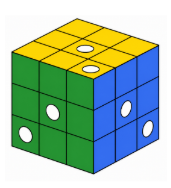
Six woodworms made their home in an old wooden cube made up of identical small cubes. Each one drilled a tunnel all the way through the cube, parallel to one of its edges. The diagram shows the entrances to the six tunnels. How many small cubes don’t have a tunnel drilled through them?
A)9 B)12 C) 15 D) 18 E) 21